
How Much Does a Website Cost in Australia? (2026 Pricing Guide)
October 1, 2026Written by Ravi Patil
Director, Digital Impact Gurus | SEO Strategist | 17+ Years in Digital Marketing
Website design costs in Australia range from $1,500 to $35,000+ in 2026. A simple template site runs $1,500 to $3,000. A custom, SEO-built business website costs approximately $20,000 to $35,000. An online store lands between $10,000 and $25,000. These prices can go as high as $50,000+
The right figure depends on factors such as the number of pages, the features you want, and whether the site is built to rank or to win leads with SEO and Google Ads.
You’re ready to build your website after months of discussions with friends, family, and business partners. But as soon as you pick up the phone to dial numbers and start asking for quotes, you get more confused.
The numbers make no sense. One agency says $3,000, another says $30,000, and both are describing something they call a “website.”
I’ve been in this game for 17+ years and have seen websites of all types and budgets. I have seen templated websites built on a minimum budget of $ 5,000 and high-quality, premium websites built on a budget above $50,000, too. The market is flooded with all types of service providers.
But first you need to be very clear about one thing:
Which website is the right choice for your business?
Grab a big double-shot espresso, and let’s compare prices for custom website design packages in Australia.
(You’re going to need all the caffeine to understand what you are paying for.)
Key Takeaways:
- A website that actually outperforms competitors in highly competitive niches needs 20 to 35 pages. 5 to 10 pages won’t cut it.
- A website is a business asset, so you need a maintenance budget for every year.
- The cheapest quote looks best on paper but is rarely the best value.
What Does A Website Design Cost in Australia (2026) – Real Cost Breakdown
Here’s what Australian businesses typically pay, by the kind of site they need.
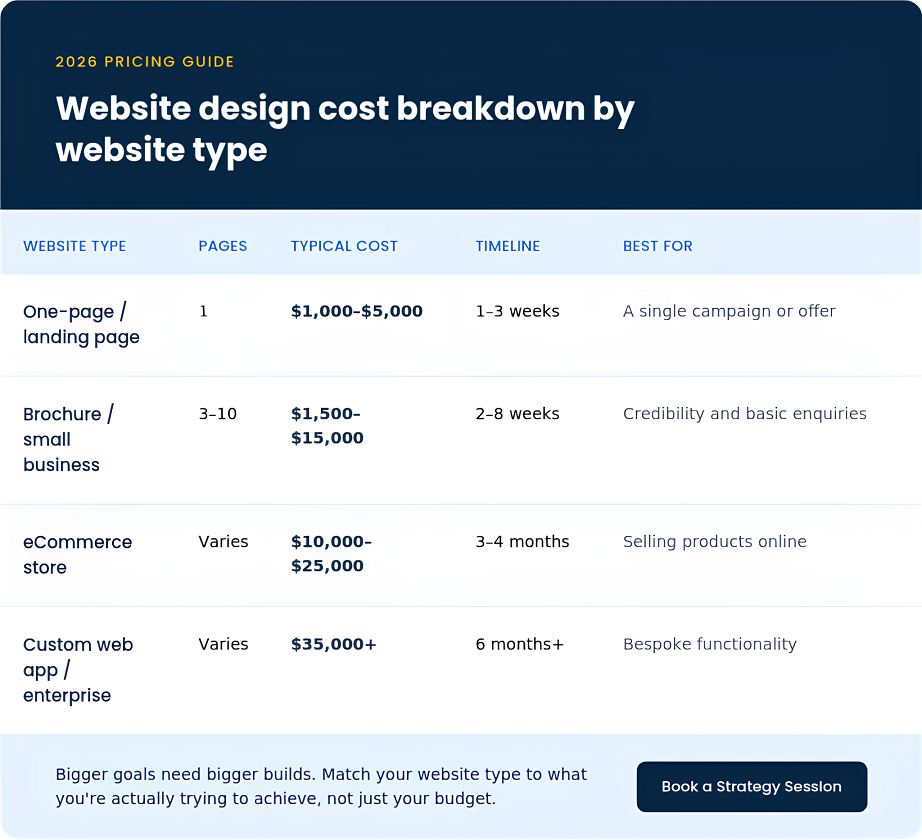
Bigger goals need bigger builds and budgets. Match your website type to what you’re actually trying to achieve. Don’t focus only on numbers or be afraid to take the next step.
Sometimes, small businesses with a smaller budget choose a templated website, so the average cost of a small business website is lower. But it might not be the best choice for you. It all comes down to where you’re on your business journey.
For more serious, professional businesses like plumbing, electricians, home renovations, or pest control, professional web design agencies cost more.
What Are You Actually Paying For?
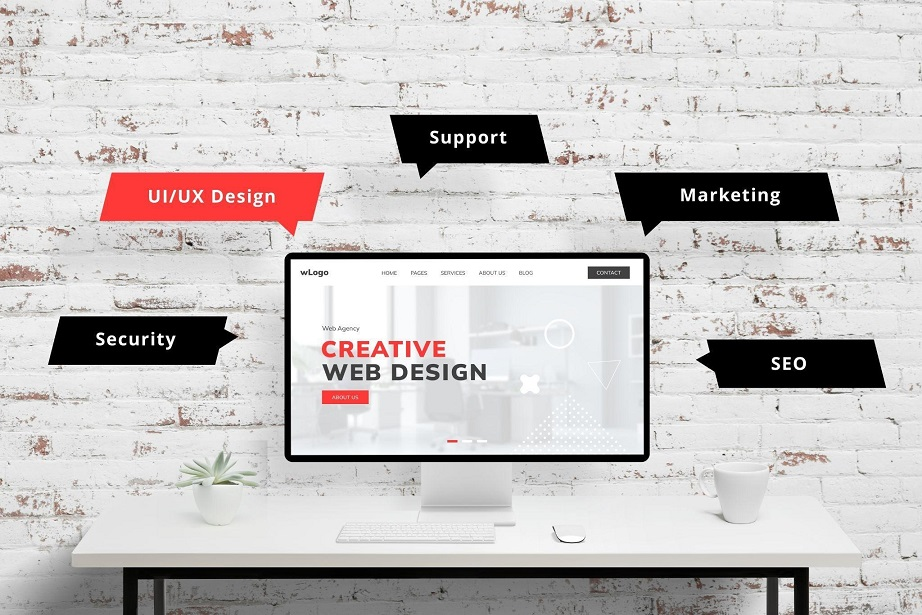
A website quote isn’t just a number of agencies bluffing in mid-air. The price comes from a stack of separate jobs and roles involved in creating the site. Experts charge more because they have a proven track record in the services they provide.
According to the Australian Bureau of Statistics (ABS), more than 91% of businesses reported that the internet met most or all of their business needs in 2024-2025, and 32% of Australian businesses received orders online through their website in the last two years. So the money you will invest in building an online presence will never go to waste.
Disclaimer: If a quote feels too good to be true or seems cheap, you may be missing or cutting one of the following steps.
Here’s exactly what a professional website design package must include.
1. Strategy and Planning ($1,000 to $4,000)
Before the design even starts, we can’t skip one crucial step: strategy development and planning.
When you hire a professional web design agency in Australia, their brand strategist will map out your ideal customer profile, business objectives, competitive analysis, website goals, user journey map, content strategy, & technical requirements.
Most cheap website quotes skip this step entirely. Remember, not having a strategy before designing or copywriting shows why many pretty websites just sit as a showcase and never bring in work.
2. Website Design/ UX/UI & Visual Design
There are two types of website design services in Australia:
- Template-Based Websites
- Custom Websites
If you use a template-based website, the problem is that plenty of websites online use the same template, making your business just another website on the internet.
But when you hire professional website designers to build a custom website, they analyse your business, study your competitors, find gaps, and then devise a custom strategy that helps you stand out in your industry.
The biggest driver of design cost is the number of pages and their layout. A ten-page site sharing one wireframe costs far less than a ten-page site requiring a unique wireframe for each page.
At Digital Impact Gurus, we offer complete wireframes, mockups, full design control, website sections, and CTA placement tailored to your business. Our brand strategist and website developer plan everything for maximum results.
3. SEO Copywriting
“Website copywriting is the process of writing clear, concise, persuasive, and strategic content for your website that uses customer psychology, copywriting frameworks, and content optimisation.”
This content persuades readers to take a specific action to drive sales, boost engagement, connect with the audience, and convert. It also builds trust, grabs attention, communicates value, and optimises for search engines.
If your content sounds vague or generic and doesn’t persuade customers to take the action you want, it loses impact. And you get no conversions, even with a beautifully functional website.
Strong web copy speaks directly to your customer’s real problem, identifies the solution they are seeking, and positions your business as the ultimate solution they need.
This process requires deep brand strategy development that includes:
- Identifying customers’ real pains and problems that keep them up at night
- Finding what they desire and need to fix their problem
- The solution and the angle they need to trust your business
- Finding competitive gaps and filling them up with copy
- Curating proven web copy frameworks customised to your business.
Whether you want a personality-led business or a product/service-led business, a copywriter can customise the copy according to your needs.
Website copywriting packages in Australia include:
- Homepage copy
- About Us copy
- Product/Service pages
- Processes
- FAQs
- Blog Posts
- Contact Us
- Location pages for SEO
You can add any additional pages as needed, such as a collaboration page, a digital products page, a store, and an opt-in page for email marketing.
Can I Use AI To Write My Website Copy?
Today, customers are tech-savvy and can identify AI-generated content from miles away. They can smell formulaic patterns and lifeless, opinion-less AI content from miles away.
We do not recommend AI content, as missing out on professional copy and using AI to write your copy kills conversions, penalises your website, and breaks your customer’s trust.
The top-performing digital marketing businesses in Australia know a high-converting website needs strategic copywriting to perform well.
So, if website copywriting isn’t included, it’s a clear red flag.
Content and Media Costs
| Item | Typical Cost |
| Professional SEO Optimised Copywriting | $300 per page (1200 words) to $600 per page (3000 words) |
| Blog Page | $350 (Approx 12oo words) |
| Stock Photography 5 photos 50 photos | $55 (Standard Licence) to $285 (Enhanced Licence)$245 (Standard Licence) to $1329 (Enhanced Licence) |
| Custom Photography & Video | $1,200 to $5,000 |
| Professional Logo Creation | $1,500 to $3,000 |
| Branding | $5,000 to $8,000 |
If you use an AI tool for copywriting and design, you’ll see your existing customers leave. Hire professionals, and you’ll see your website quality and customer base grow fast.
4. Website Development
According to Forbes, 75% of website visitors judge a website’s credibility based on its design.
Development is the technical phase where the entire system is built, created, and run. Shortly, it’s where your creative vision starts coming to life.
This further includes coding, content management, integration, payment flows, contact setup, quotes, and booking.
Main parts of website development include:
- Front End is the part you see and click, using HTML for structure, CSS for style, typography, colours, and layout, and JavaScript for motion and dynamic sections like forms, animations, and pop-ups. This could include mobile iterations of the site.
- Back End is the hidden side that runs on a server and handles data storage, security, and user accounts. This is the confusing part that users never see: complex databases, application programming interfaces (APIs), and programming languages.
The platform you build on also changes the cost. A normal business site runs on WordPress, Webflow, or React. An online store needs Shopify, WooCommerce, Magento, or a headless setup on Next.js with a Node.js backend.
5. Functionality
Website functionality refers to the features that improve a site’s overall ability to work efficiently and help customers complete specific tasks.
As mentioned on GoDaddy, this includes:
- Navigation – menus, search bars, internal links to help customers move between pages.
- Content: Information, FAQs, and a call to action.
- Forms and Interaction – newsletter sign-ups, contact submission, or user feedback.
- Performance and Speed – fast loading times and mobile responsiveness.
- Security: SSL certificate, HTTPS encryption to protect user data.
Besides, it includes booking systems, member logins, payment gateways such as Stripe and Afterpay, and CRM integrations. It takes real build and testing time, and each element adds to the price.
6. SEO Foundations
Most businesses in Australia treat SEO like an add-on. Some will get it, some won’t. But businesses ranking at the top of Google know their position and organic traffic would never be possible without consistent SEO.
If you’re wondering, “Is SEO dead?” Here’s my take on it.
No, SEO is not dead. People have been saying this for years now, and SEO still performs and brings in business. Tactics change, and strategies evolve, but the foundation remains the same. AI overviews have definitely changed how we work.
Read below to see what changes we have made in our strategies.
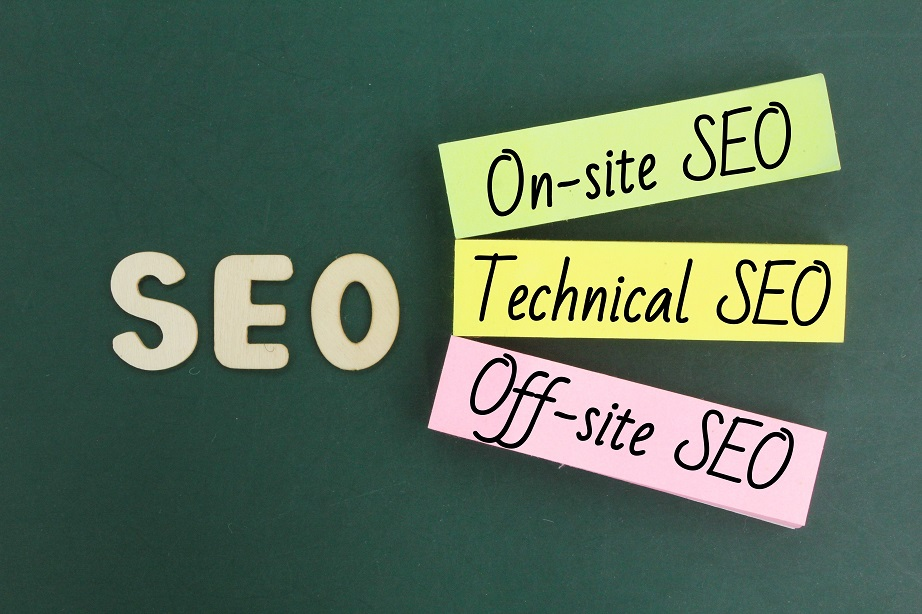
SEO helps companies grow their visibility, attract high-intent customers, and build trust through strategic search engine optimisation. It involves.
- On-Page SEO
- Off-Page SEO
- Technical SEO
- Content Briefs
- Content Review
- GEO Implementations
- AI-Search
- Meta Descriptions
- Meta tags
- URL structure
- Image optimisation
- Internal and external linking
- Google performance metrics
- Schema markup
- Core web vitals
In 2026, SEO is far different from what it was a decade ago. With AEO and GEO taking centre stage, the best SEO agencies in Australia are prioritising these in their SEO strategy.
AI SEO: Your Website Has To Be Built For AI Search Now
Search engines have moved beyond articles and blogs to AI overviews. People no longer just type into Google; instead, they ask ChatGPT, Gemini, and Perplexity, and those tools pull answers straight from websites.
If your site isn’t structured for this, you’re invisible in the fastest-growing part of search.
An AI-friendly build means clean structure, clear headings, schema markup, and copy that answers the questions people actually ask. We build this into every site by default. A template that was never structured for AI won’t show up there.
A question worth asking your website designer is whether they optimise the website for AI search.
Our Customised SEO Services for Australian Businesses include:
Local Optimisation: Setting up and refining map listings and profiles to capture nearby search traffic.
Technical Audits: Fixing site architecture, speed issues, and mobile usability so search engines can read pages easily.
Content strategy: Writing original, research-backed high-intent content that’s helpful and targets specific buyer questions and conversational phrases.
AI and Brand Authority: Earning positive mentions, reviews, and citations across the web so AI platforms recognise the brand as a true authority and trusted source.
7. Mobile-First Development
Most people see your website on a phone today. According to Statista, mobile has been the majority of web traffic since 2016. Google now indexes the mobile version of your site first.
At Digital Impact Gurus, we design your website with a mobile-first approach, optimised for larger screens such as tablets, laptops, and desktops. Every page is tested before launch.
Speed optimisation is also a crucial part of mobile-first design. Google’s own research found that 53% of mobile visitors abandon a page if it takes over three seconds to load, and a slow site burns the traffic you paid to get.
You can check your own website speed for free with Google PageSpeed Insights. A strong score means fast, stable pages that search engines and visitors reward. This stage covers responsiveness, performance, security testing, and pre-launch checks.
8. Testing and Launch
You should never launch a website without first checking a staging version. It’s how you catch a broken form before a customer does.
Before your site goes live, we test it across devices and browsers. Then we load it onto a private staging version for you to approve.
Tip: Conduct the test yourself. Go through every single page, every link, and test every button to find the problems before your customer does and leaves.
9. Project Management
A key element in building a high-converting website in Australia is having someone manage everything to ensure a seamless experience.
A project manager keeps the process running smoothly by keeping everything on track and on time, and by communicating with the team and you. It looks invisible on a quote, but it’s the difference between a smooth build and customer experience and a months-long mess.
Website Security Also Costs Money
According to W3Techs, around 40% of sites run on WordPress. That also makes it the biggest target for attacks, usually through outdated plugins. That’s why plugins are the most common way in.
The Australian Signals Directorate’s latest Cyber Threat Report states that over 84,700 cybercrimes are reported roughly every 6 minutes. The average incident costs a small business around $56,600.
Proper maintenance handles core updates, plugin patches, malware scans, firewalls, and backups. The key thing to understanding is that prevention is always cheaper than recovery.
This is yet another reason we build hosting, updates, and security into our packages rather than leaving you exposed. A hacked site can drop out of Google and go offline for days while you lose customers and money. But cleaning that up costs far more than the maintenance that would have prevented it.
Template Vs. Custom Website
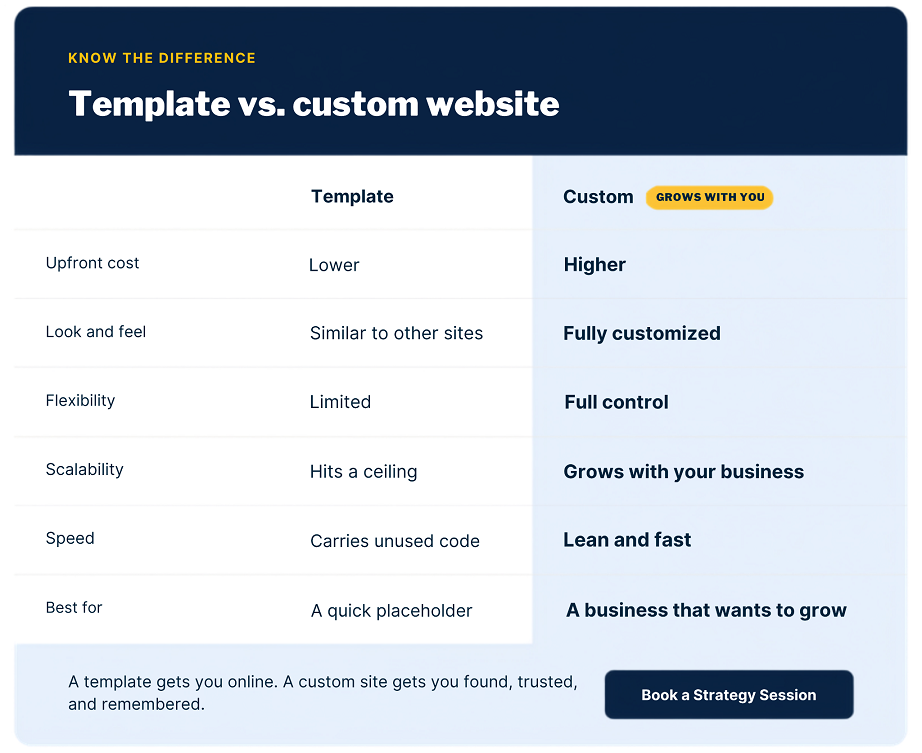
A custom website is built around your brand, your users, and your goals. It isn’t forced into a layout used by thousands of other businesses.
Here are the main options you can opt for (we don’t recommend templates or DIY).
1. Template or Theme-Based
Your designer takes a pre-made theme and skins it with your logo, colours, and copy. It looks more polished and refined than a DIY build, and it’s still fast to turn around, but the bones underneath belong to a theme that thousands of other businesses have also bought into.
Your competitor down the street might be running the same layout with a different palette. That’s why we don’t recommend this route for a business that wants to stand out and be an authority in their niche.
2. Custom Design on a CMS
This is where “custom” starts meaning what it says. The site gets designed in Figma, built specifically around your brand and your user flow, and developed on WordPress or Webflow.
You keep the flexibility of an established CMS (easy content updates, a huge plugin ecosystem, a developer market that isn’t hard to find later) while getting a site that was actually designed for your business.
3. Fully Custom, Headless, or Coded from Scratch
This is a fully bespoke website. Custom architecture, no theme or template underneath.
This is the right call when you need something a CMS genuinely can’t handle, when performance at scale is non-negotiable, or when your product itself is technical enough that the website needs to behave more like an application than a brochure to showcase your services.
According to Stanford research, around three-quarters of people judge a business on its website alone. A dated or clunky site lowers trust and can cost you sales long before you have a chance to build it.
In our experience, custom sites convert 20 to 30% better than generic templates. When the pages are built around your customer’s needs and desires, they are much more likely to take action.
A custom site also grows with you. Your business won’t look the same in two years, so your website needs to update accordingly. But a template website doesn’t give you much freedom to upgrade, plus the site is always yours, unlike renting out a template.
How Integrations Change the Price?
Connecting your site to other systems is where costs climb fastest. A basic contact form is quick, but a booking system that syncs calendars and takes deposits is a much bigger job.
The same goes for a CRM link, a customer login area, or a subscription-based payment gateway. Each one is a separate job to design and test. If a quote includes these, ask exactly what’s covered. If it doesn’t, that work will show up as an extra later.
McKinsey research found that most large IT projects run over budget and under-deliver on value.
The Cost of Doing Nothing
A slow, dated, or missing website loses customer trust and leads before a customer ever contacts you. Today, most people research a business online before they call, and they judge fast. On top of that, AI engines now pull data from credible websites that publish regular content.
A thin, unstructured site remains invisible in AI answers, too. So doing nothing also has a price, and it’s usually higher than the build itself.
DIY Vs Freelancer Vs Web Design Agency – Which Costs More?
DIY Builders: $0 to $2,000
Tools like Wix, Squarespace, GoDaddy, Canva, and Duda are the cheapest option and quick to start. But these fast solutions come with the sacrifice of real customisation, SEO performance, load speed, and conversion strategy.
It suits hobby projects, personal sites, and very early-stage businesses testing an idea.
But templates lock your layout, so you can’t stand out. SEO structure is also weak, so organic ranking is hard.
The platforms also cap your growth, so scaling means starting over, and you don’t fully own the site. So, a price hike or policy change can trap you and your business without any professional help.
What You Get and Don’t Get in DIY:
Lowest cash outlay but highest internal time requirement
- Template/platform constraints, ownership and migration considerations
- Best for validation, simple presence and very limited budgets
Freelancer: $2,000 to $8,000
More affordable than an agency, and fine for mid-range budgets with variable breadth of expertise. Keep in mind that on freelance websites, custom design is rarely on the table, quality can vary wildly, and you’re often hiring a designer rather than a marketer.
Ongoing support is limited, and you have a single point of failure if they ghost you.
Weak research also hurts your SEO and ads, and weak design hurts conversions. It suits businesses with a clear brief who can manage the project themselves.
Offshore developers push the price lower, sometimes to a few hundred dollars. But that low price tag comes with plenty of sacrifices on your end. Time zone gaps, limited support, slow turnaround, and wildly varying quality are common. If you go this route, budget an extra 20 to 30% for revisions and local fixes.
Before booking, check whether they comply with Australian regulations such as AHPRA, the Privacy Act, and accessibility standards.
What You Get and Don’t Get with Freelancer
- Mid-range pricing and variable breadth of expertise
- Need for clear scope, project management and post-launch arrangements
- Discuss communication/time-zone/continuity risk without dismissing offshore talent
Advantages of Working with An Agency

A 20-page website sits around $20,000, and includes keyword research and competitor analysis, a conversion-focused strategy, SEO built in from day one, copywriting, fast loading and strong Core Web Vitals, ongoing support, plus integration with your SEO and ads.
It suits businesses that are serious about generating leads from their website.
The cost is definitely higher upfront in exchange for a multidisciplinary approach to strategy, design, development, SEO, and PM.
- Higher upfront fee in exchange for multidisciplinary strategy, design, development, SEO and PM
- Better fit when the website is a meaningful revenue/lead-generation asset or requires ongoing support
When does a website pay for itself?
Think of your website as an investment in your business with a high upfront cost, but after a year, you’ll see you’ve already recouped it.
Say a new client is worth $2,000 to you over the year. A $25,000 custom site needs to bring in about 13 new clients to cover itself. Spread across twelve months, that’s roughly one extra client a month. For most service businesses, that’s a low bar.
How Much Should You Budget? Three Practical Scenarios

Here are three common scenarios we build regularly and what the money buys in each.
Scenario A: Lean local-service custom website (approx. 20 pages)
This is a fit if you run a straightforward service business. People find you, check you’re legit, and call or fill out a form. You don’t need a booking portal or a stack of integrations.
You just need something fast, clean, and built to rank for your area and service.
For you, the budget sits around $20,000. This includes a simple service site, a clear conversion path, modest content volume, and minimal custom functionality.
- Strategy and planning: $1,500 to $2,500 for competitor research and mapping out your service and location pages.
- Design: $3,000 to $4,000 for custom wireframes that are built according to your customer journey.
- Development: $5,000 to $6,500 to build it on WordPress or with forms and structure that work properly.
- Copywriting: $6000 for your homepage, service pages, and a starting batch of location pages (approx. 20 pages)
- Launch: $1,000 to $1,500 to test, stage, and go live.
- Ongoing (year one): $600 to $2,400 for hosting, updates, and basic SEO.
Scenario B: Growth-focused lead-generation website (approx. 35 pages)
This is for businesses past the proving stage and want the website to carry the actual weight of business. It needs to rank for terms with real search volume and generate leads worth following up on.
Budget can go up to around $30,000 to $35,000.
- Everything included in scenario A
- Custom UX built around how your customers actually move
- A bigger content architecture, more service and location pages built for search terms with real competition
- Analytics and conversion tracking from day one, so you know what’s working in month two instead of guessing for a year
Paying more upfront reduces the need to rebuild and rework the site’s foundations for months to come.
Scenario C: eCommerce or custom-functionality website

This suits businesses that sell products, take bookings, or run something closer to an application than a brochure. You need payments, inventory, shipping rules, maybe a customer portal too.
The budget can run from $10,000 to $25,000 for a standard store and can climb past $ 35,000 once you add custom logic on top, like deposits, subscriptions, and a member’s area.
The mistake we see most often at this tier is trying to launch with every feature enabled at once. Split it instead:
- Phase 1 -Must-have for launch: product catalogue, checkout, payment gateway, shipping, and the pages that actually get you found in search.
- Phase 2 – Once you’re live: loyalty programs, subscription tiers, advanced filtering, anything that improves the experience but isn’t stopping a sale today.
Launch lean, then build Phase 2 once real customer behaviour shows what’s worth adding.
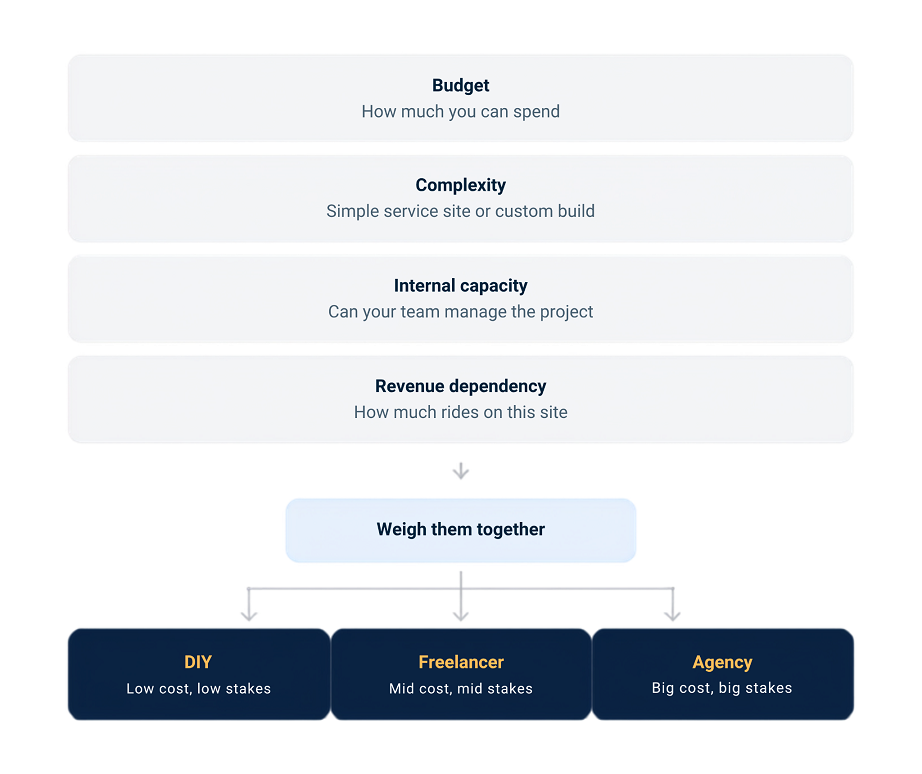
A Quick Decision Tree
If you’re still deciding which path is right, run through it in this order.
The Hidden and Ongoing Costs After Launch
A website has running costs that most providers explain upfront. But you also pay hidden costs every year, even after the site is up and running. Here’s what you should budget for after launch.
| Ongoing Cost | Typical Range |
| Domain registration and renewal | $10-50 a year |
| Dedicated Hosting, managed hosting and infrastructure | $20-$100 a month |
| Maintenance, updates, backups and security | $100-$500 a month |
| Premium plugins, themes, Saas tools and integrations | $50-$300 a month |
| Support retainers and on-demand development | Retainer or hourly |
| SEO, content, analytics and conversion optimisation | $500-$7,500 a month |
| Business email and email marketing tools | $10-$200 a month |
1. Support and Optimisation:
Small tweaks, adding new pages, or editing existing ones, and small fixes as your business grows.
2. Domain Registration:
Your web address, usually $10 to $50 a year, that you buy. We set up your email on Microsoft 365 or Google Workspace. (Domain is your web address or URL, and hosting is where the site’s files live.)
3. Hosting and Updates:
With Digital Impact Gurus, you don’t pay for these separately. Hosting and website updates are included in our packages, and we host on Australian servers in Sydney. Cheap offshore hosting may look tempting, but it often leads to slow speeds and poor support that hurt your SEO.
4. Ongoing SEO and Analytics:
Getting found online consistently has its own monthly bill.
In a 2025 survey by Neil Patel, most businesses (50.8%) spent between $500 and $7,500 USD (that’s approx $750 to $11,000 AUD) a month on SEO.
The most common band was $1,000 to $2,500 USD (that’s approx $1500 to $4000 AUD)
5. Technical Fixes:
Every year, your website will need technical fixes, like broken links, plugin conflicts, and speed issues. The sooner you catch them and fix them, the better.
6. Content Updates:
A site that never changes goes stale for customers, and Google needs a monthly refresh. We do it with high-quality, human-written blog posts.
7. Tools and Licenses:
Serious sites run on a stack of paid tools, usually somewhere between 5 and 20.
| Tool Type | Typical Cost |
| Premium Plugins | $50 to $300 a year each |
| Email Marketing | $20 to $200 a month |
| Social Media Tools | $50 to $300 a month |
| Analytics and Reporting | $100 to $500 a month |
| CRM or Booking Tools | $50 to $500 a month |
Many businesses in Sydney never budget for these costs, and when the website still demands budget after year 1, they feel burdened and betrayed. We’ll flag any costs that come up in advance so you’re mentally prepared for how much you’re going to invest and nothing comes as a surprise.
8. Occasional Website Refresh:
A good benchmark is a design refresh every two to three years to keep the site in line with current standards. If your business is evolving rapidly, you will need a design refresh sooner than expected.
Total Cost of Website Ownership Year 1 vs Year 2 and beyond
| Website | One-off build cost | Year 1 recurring | Year 2 and afterwards recurring |
| Template Starter | $1,500-$3000 | $600-$2,400 | $600-$2,400 |
| Custom Business Website | $20,000-$35,000 | $2,400-$7,200 | $2,400-$8,400 |
| eCommerce Store | $10,000-$25,000 | $3,600-$9,600 | $3,600 -$9,600 |
Tool prices tend to rise over time, so ownership costs can climb slightly in later years.
How Long Does a Custom Website Take?
If you want a solid website, it’s better not to rush. Here’s a realistic timeline we give our clients.
A 20- to 35-page website takes four months.
- The first two months go to competitor research, site structure, human copywriting, and design.
- The third month is development.
- In the fourth month, we show you a web preview and make every change you need.
- Then we test and launch.
A 60- to 70-page website takes five to six months, since the extra pages require more copywriting and development.
The most common cause of delay is content sitting on your side waiting for sign-off. The faster you approve, the faster you launch.
Does Website Pricing Vary by City in Australia?
Search “web design cost Sydney”, and you’ll get different results than searching the same thing for Adelaide and Perth.
This matters when hiring an SEO agency, too: if you offer a local service limited to your area, your search results will not look the same as those of someone offering services across Australia.
Customers type in their own city because that’s how they think about hiring a local provider. Sydney, Melbourne, Brisbane, Perth, Adelaide, Gold Coast- the intent behind all of those searches is close to identical. The person just wants to know what they’ll pay before they start requesting quotes.
You might search, “Best digital marketing agency Sydney” or “Digital marketing agency near me.” Both will show local results ranked for location-specific keywords.
An agency based in central Sydney or Melbourne carries higher office and staffing overhead than a team working out of a smaller city or operating fully remote, and that overhead shows up somewhere in the rate card. Local market rates matter too.
What a Gold Coast small business expects to pay for a website isn’t necessarily what a Perth mining services company expects, simply because of who else is competing for that same client’s budget.
How to Compare Website Quotes and Choose the Right Provider
You’ve called three companies and received three different quotes that are worlds apart. Here’s a quick guide to judging which one is the right provider for your business.
- Compare like-for-like scope, rather than just price. A quote for $5,000 might include only 5 pages, while another for $28,000 might be a 28-page custom website with built-in SEO. Don’t be fooled by numbers alone; ask what’s included, especially whether it’s a template or custom, AI-generated content or human-written copywriting, and how many words per page will determine the cost.
- Ask directly about what’s included: Strategy, design rounds, development, copywriting, SEO setup, analytics, testing, launch, training, and support. Get each one of these confirmed. Make sure the package includes revisions and copywriting; otherwise, you’ll be stuck with paying for both later.
- Confirm the timelines, milestones, the payment schedule, and the change-request process.
- Confirm who owns the site. This includes domain, hosting, analytics, design files, website code and licenses. We said this earlier, and we’ll say it again: if a provider hesitates when you ask who owns the site, something shady is happening.
- Check their actual portfolio. Recent work samples prove industry experience. Ask for recent work in your industry, real references, and client testimonials.
- Ask how they handle things after launch. Bugs, security updates, ongoing improvements and much more. Someone has to own this once the site goes live, and if you have no idea how the backend runs, you’ll definitely need post-launch support.
12 Red Flags in a Web Design Quote
- No portfolio at all or one full of dated work.
- Template sold as custom because a skinned theme is not a custom build.
- Slow or vague replies before you’ve paid; it won’t improve later.
- No discovery process; a good team learns your business before quoting.
- No wireframes or mockups to see in advance and understand where you’re headed.
- Design with no conversion strategy means no planning for acquiring leads.
- A vague scope you cannot pin down. The extras will shock you at every step.
- No SEO or AI-friendly build means you have a dead website, and nobody can ever find you except when you hand them the link.
- No unique content on every page (especially on location pages; content is the same, just change the suburb). Recently, a plumber had 406 locations with the same content, with 1200 words per page. For a plumbing business, we need at least 3000 words per location.
- No post-launch support. Your site needs updates and someone you can call.
- Guarantees that sound too good to be true. No honest agency will promise number one ranking on Google right away.
- A quote that’s way cheaper than others in the industry. There’s a big chance they will just provide pretty graphics and nothing more.
Protect your investment: contracts, ownership, and due diligence
A professional website is a business asset, so treat it like one. A clear contract prevents most disputes.
Your agreement should spell out:
- The scope and deliverables
- Who owns the site and content (it should be you)
- Payment milestones tied to project phases
- A formal process for changing requests
- Support terms after launch
Do your homework before signing up, too.
- Verify the provider’s ABN and insurance
- Speak to two or three recent clients
- Review a portfolio of similar work
- Confirm what post-launch support is included
- And clarify who owns the domain, the hosting account, and admin access
Why Sydney Businesses Choose Digital Impact Gurus?
Plenty of agencies can hand you a website that looks sharp for the client meeting and then does nothing once it’s live. Our websites make money every day.
We’re based in Parramatta and work with businesses across Sydney and right across Australia.
With over 17 years in the trenches, we’ve built for plumbers, electricians, pest control operators, locksmiths, builders, and renovation specialists who need their phone ringing. We’ve done the same for lawyers, physios, chiros, audiologists, doctors, and funeral directors- industries where trust comes long before you pick up the phone to book.
We stand by one rule. We don’t simply build websites without real prep and strategy. We design every pixel after in-depth strategy development, competitor research, and keyword research.
We also build high-traffic location pages with the right amount of content, tailored to your industry and suburbs. A design that reflects your brand and content with such depth that it ranks in Google and AI overviews.
You also get an unbeatable SEO strategy designed to drive warm leads and visitors who are ready to buy. And if you want traffic starting this week instead of next quarter, our Google Ads team knows how to flip that switch properly.
Website Cost FAQs
How much does a custom website cost in Australia?
Custom websites in Australia typically cost $2000 to $35,000, depending on the number of pages, functionality, and services included. A simple template site typically costs $1,500, and an online store costs $10,000 to $25,000.
How long does it take to build a full custom website?
It takes about 4 months to build a 20-35-page website and 6 months or more to build a website with 60 to 70 pages. However, the timeline depends on the design’s complexity and how quickly you review and approve it.
Does my small business need a website?
Yes, a website gives your business a place to establish credibility, explain your products or services and make it easier for potential customers to find and contact you.
